

Web development outsourcing for agencies: how to choose your white-label partner
Choose a white-label web development partner: the 3 models, 7 questions to vet a subcontractor, the traps to avoid, and real market prices.
Two years ago, an agency sent me a brochure site three days before the client launch date. The subcontractor they had hired had vanished two weeks earlier: no usable deliverable, no staging access, not a single line of documentation. The agency’s own designer, who knew WordPress only from watching over someone’s shoulder, ended up at 11pm staring at a theme he had no idea how to edit, while the client was already calling to ask where “their site” stood. The agency reached out to me in a panic. I salvaged what could be salvaged, rebuilt what had to be rebuilt, and the site went live the next morning, with roughly half the budget already burned on work that had to be redone from scratch.
I have watched versions of that scene replay for more than ten years. I provide white-label web development for French agencies: they sell, I build, the end client never knows I exist. The principle is simple. Choosing who builds behind you is not.
This article is the view from the other side of the mirror. I am going to walk through how I would choose a subcontractor if I were the agency signing the contract and carrying the responsibility for someone else’s work.
Why agencies outsource
Hiring a developer takes three to six months between the decision and the first shipped line of code: writing the job post, interviews, onboarding, ramping them up on your process. And once hired, it is a fixed cost, every month, whether the pipeline is full or empty. Outsourcing flips that: a variable cost, switched on project by project, testable on a one-week job before committing to anything longer.
In my experience, three situations push an agency toward outsourcing:
- A temporary overload. Two projects signed the same week, a team already at capacity, a client deadline that will not move.
- No in-house developer. The agency sells design, strategy, marketing, but has nobody in-house for the technical side, and not enough volume to justify hiring one.
- A skill gap on one specific project. The team is solid on WordPress, but the client wants Shopify, or the other way around.
None of these three reasons is an admission of weakness. It is a capital-allocation decision, like any other. An agency that outsources well keeps its in-house team focused on what actually differentiates it: strategy, client relationships, creative direction. It leaves the repetitive, time-consuming technical production to someone whose full-time job it is. It is the same math as a communications agency outsourcing its printing instead of buying a press.
The 3 outsourcing models
Every outsourcing relationship I have seen falls into one of three categories, and they do not pay off the same way for either side.
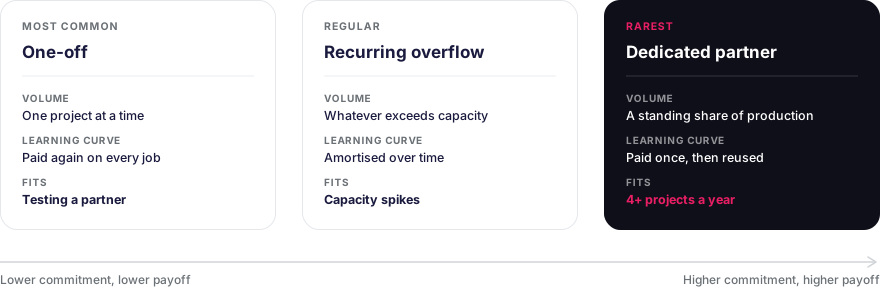
One-off is the most common: a single site, a single job, a fix. No commitment beyond it. It is fast to start, but every new job retraces the same learning curve: the subcontractor rediscovers your habits, you rediscover their limits.
Recurring overflow looks similar in form, but the regularity builds routines. The agency sends whatever exceeds internal capacity, and the subcontractor already knows the expected brief format, the usual timelines, the tone to use with end clients.
The dedicated partner is the most profitable model for both sides, and the rarest. The agency hands a meaningful share of its technical production to a single subcontractor, who becomes an extension of the team without ever wearing its name. Some agencies even credit “our development partner” internally, so the whole team knows who to route a technical request to without relearning the history every time. This model asks for an upfront investment of trust on both sides. Once it is in place, it pays back in execution speed and consistent quality.
The 7 questions to ask before handing over a site
Before signing with a subcontractor, whether one-off or on track to become a dedicated partner, I would ask these seven questions. Their answers decide whether the worst day stays manageable or turns into a spiral.

- Is there a staging environment separate from the live site? Without it, every update or test happens directly on what the client sees. The next question follows almost automatically from this one.
- Is a backup taken before every update? Not “a backup exists somewhere.” A fresh, verified backup, taken right before touching the site.
- Is there a written QA process? A checklist, even a short one, applied before every delivery, not an eyeball check that varies day to day.
- Who talks to the end client? If the answer is “me, directly, without going through you,” that is a structural problem, not a detail. White-label terms get negotiated before the first project, not after the first incident.
- Can they sign an NDA? A serious subcontractor should be willing to sign a reasonable, clearly scoped one. Refusing the principle outright, as opposed to negotiating a specific clause, is the weak but reliable signal here.
- Are deadlines contractual, with consequences if missed? An “indicative” deadline binds nobody. A deadline written into the quote does, provided it names what it depends on: the assets, approvals and answers you owe on time. A firm date only holds when both sides’ inputs are on the clock.
- What happens after delivery? Who maintains the site in six months: the subcontractor, the agency, nobody? This is the question almost everyone forgets to ask, and the one that costs the most a year later.
Seven questions, asked once, before the first project. They prevent most of the bad surprises I see happen afterward.
The 3 traps
The first trap is the cheapest bid that ends up costing double. A quote 30% lower than the rest almost always hides a shortcut somewhere: no QA, no staging, a pirated premium theme instead of a legitimate license. Fixing a badly built site is systematically more expensive than building it right the first time, because you have to understand what was done before you can even start correcting it. If you already have one of those sites on your hands, the 5-point audit I run on every inherited site is the fastest way to find out how deep the problem goes before you commit a budget to it.
The second is the solo operator with no continuity plan. The problem is not being solo; it is having no one lined up behind you. No documentation, no systematic backups, no handover of access, so the day the developer gets sick or their life changes, the agency inherits a site it cannot get back into. Ask who steps in, and how fast. If there is no answer, the risk is entirely yours.
The third is the subcontractor who eventually poaches your clients. This happens more often than people think: a subcontractor who had access to the end client during production, and who, two years later, reaches out to them directly for maintenance or a redesign. I have also seen the quieter version, an agency discovering after the fact that its subcontractor had slipped their own name into the site footer, small enough to miss at a glance but indexed by Google. This is why white-label terms need to be contractual, written down, not just a verbal understanding.
What it actually costs
The ranges below are rough, drawn from what I see on the French market. Treat them as orders of magnitude, not a quote.
| What you are buying | Rough range | What moves it to the top of the range |
|---|---|---|
| Subcontracted brochure site | €800–€2,800 | Complexity, expected level of polish, the subcontractor’s process |
| Monthly maintenance, per site | €40–€250/month | Plugin updates only at the low end; active monitoring and emergency restores at the high end |
| Test project, to qualify a partner | €150–€500 | Deliberately small. The point is the process you observe, not the deliverable |
Here is what moves those numbers, in the order I see them matter:
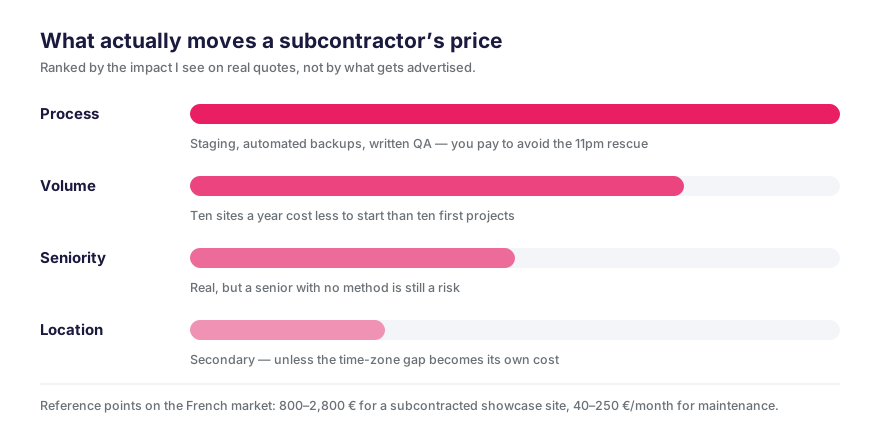
Process comes first. A subcontractor with staging, automated backups, and documented QA charges more than a solo operator working “by feel,” and it is justified: you are paying to avoid reliving the scene this article opened with. Volume comes next. A dedicated partner handling ten sites a year gets rates a one-off fix does not justify, because every new project costs less to start: the subcontractor already knows your habits, your stack, your typical clients. Seniority matters too, but less than process: a senior developer with no method is still a risk, even if technically strong, while a more junior profile with a solid process delivers predictable results. Location, finally, plays a real but secondary role next to the previous three. A subcontractor based outside France often costs less for equal quality, as long as the time-zone gap does not become a hidden cost in lost back-and-forth.
The factor most agencies shop on is the one that matters least. Location and headline day rate are the two easiest things to compare, which is exactly why they get compared. Process is harder to read from a quote, and it is the thing that decides what the project actually costs you by the end.
Our own numbers are published rather than quoted case by case. You can read them on the pricing page before we ever speak.
What we do
This is exactly what we do at Digitalmonstr: white-label web development for agencies, with the rules of the game public instead of buried in a quote. Systematic staging, backup before every update, contractual white-label terms, deadlines that hold. When the project is an e-commerce build rather than a site, the same terms apply to our white-label Shopify work. If you would rather judge on results than promises, our WordPress maintenance offer follows the same logic, built around a published 5-point audit so you know exactly what we check before billing you anything.
None of that is a reason to trust us on sight. Who we are and what we have shipped are both public, and the work is the part worth looking at.
FAQ
How much does web development outsourcing cost for an agency?
A subcontracted brochure site usually runs somewhere around €800 to €2,800, depending on the provider’s profile and the project’s complexity. Monthly maintenance sits roughly between €40 and €250 per site. A subcontractor’s process (staging, backups, written QA) weighs more on price than location or seniority alone.
How do you ensure that a subcontractor respects white-label terms?
By contract, not by verbal trust. Spell out, in writing, the ban on direct contact with the end client and the ban on client poaching, with consequences for breaching it. A serious subcontractor will sign reasonable terms like these; the ones worth worrying about refuse the principle rather than negotiate the wording.
Do you need an NDA with a web development subcontractor?
Yes, every time, even for a one-off job. A reasonable, clearly scoped NDA costs a serious subcontractor nothing. Be wary of someone who refuses the idea altogether, less so of someone who asks to tighten an overly broad clause, which is just professionalism.
One-off outsourcing or a dedicated partner: which one should you choose?
One-off works to test a relationship or cover an isolated spike. A dedicated partner becomes more cost-effective once volume passes three or four projects a year, because the subcontractor no longer needs to relearn your habits with every job.
What should I do if a subcontractor delivered a badly built site?
Get the site audited before deciding anything: sometimes a partial rebuild is enough, sometimes you have to start over. Do not rely solely on the same subcontractor to assess the damage they caused. A second opinion, even a quick one, often changes the diagnosis.
Related articles

How to update WordPress plugins safely (after the update that killed a checkout at 9pm on a Friday)
The monthly routine that keeps updates from breaking a checkout: verified backup, changelogs, small batches, and how to roll back when it breaks anyway.

The 5 things I check when a WordPress site lands on my desk
A war-story WordPress site audit checklist from someone who fixes broken sites for a living. 5 things, in order, before anything else.

How to change a text dynamically in WordPress using PHP?
A simple PHP filter snippet to replace any hardcoded text output on your WordPress site dynamically, without editing theme files. Drop into functions.php.